|
 |
Journal Archive >
2001 > September Father David O'Leary
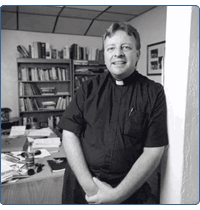
Ministering to the spiritual lives of students Students have questions. Father David OÕLeary has gathered answers. OÕLeary, the universityÕs Roman Catholic chaplain, has published a ÒprimerÓ on Catholic belief, inspired by the many questions about faith and observance heÕs been asked over the years. As attendance grows at campus Masses and at Catholic Center activities, it appears the book is filling a need. ÒThe numbers [of students participating in religious activity] are way up,Ó says OÕLeary. The volume, Roman Catholic Beliefs and Prayers: A Handbook for Those on a Spiritual Journey (The Catholic Center at Tufts University, 1999), is the first of three publication projects that OÕLeary has tackled recently. His other works address more theologically complex topics such as end-of-life issues and economic justice. Yet, as a full-time chaplain, his day-to-day focus is on the often-evolving spiritual life of students. ÒStudents are looking to make faith decisions on their own,Ó said OÕLeary. ÒTheyÕre no longer in the family they grew up in.Ó Examining matters of faithÑand seeking informationÑare part of the process of Òsearching out answers to the big questions,Ó he said. Sometimes, itÕs a matter of helping students take a deeper, more sophisticated look at the Catholicism of their childhood. ÒIf you grew up Catholic, you may have misconceptions,Ó OÕLeary said. ÒIn every other part of your life you grow up; students forget that itÕs the same with religion, too.Ó For anyone with questions or misconceptions about the Roman Catholic faith, OÕLearyÕs book provides a starting point. The book offers an explanation of the central beliefs and practices of the church, written with an eye toward the uninitiated; a section on the rights and responsibilities of Catholics within the church; a play-by-play description of the celebration of the Mass; a section on Roman Catholicism and voting and the text of several prayers. The book originated as a spiral-bound volume OÕLeary first put together in 1998. It became very popular among students, but Òwhen other parishes started calling for the books, I knew I had something there.Ó He switched over to a bound format and published the book through the Catholic Center at Tufts. All proceeds from the book, which sells for $12.50, go toward the Catholic Center. Publication of the book comes at a time of increased interest in faith and worship on campus. ÒAll of the chaplains are finding that experience,Ó OÕLeary said. Close to 300 people have been attending the 10 p.m. Sunday Masses at Goddard Chapel. Participation is also up at the Catholic Center, located in a former Knights of Columbus hall on Winthrop Street across from Sacred Heart Church. The center offers weekly scripture discussions, monthly dinners and student outreach and social justice activities. During finals, the building is kept open all night as study space. OÕLeary is one of only two full-time chaplains assigned by the Archdiocese of Boston to an area college; the other is at Harvard. ÒTufts is held in very high regard by the Archdiocese of Boston,Ó OÕLeary said. ÒThe archdiocese sees the future leaders of the world as being right here.Ó Before coming to Tufts in 1998, OÕLeary served in parishes in the Boston area and as a professor of moral theology and spirituality at Saint MaryÕs Seminary and University in Baltimore. He was a chaplain in the Air Force Reserve, teaching at the academy in Denver and at Air Force University in Alabama. In addition to his duties as chaplain, OÕLeary is a lecturer in comparative religion at Tufts. One of his upcoming publications, ÒSeeking the Path of GodÕs Justice: An Analysis of the Justice of the Roman Catholic BishopsÕ Pastoral Letter on the Economy,Ó is based on material for a class he teaches at Tufts. His other project is the publication of his dissertation at Oxford University, which examines the question of whether it is morally acceptable to withhold food and water from a person in a persistent vegetative state. He concludes that in accordance with church teachings, such a move can indeed be permissible under some conditions. ÒThe Roman Catholic Church has always said that you do not have to use extreme measures to preserve life,Ó OÕLeary said. ÒIn other words, you donÕt have to be hooked up to every machine under the sun; you donÕt have to push the envelope. In extreme situations, a case could be made that in a persistent vegetative state, food and water should be considered extreme means.Ó ItÕs important to understand the difference between Òletting dieÓÑwhich would be a Òforeseen but unintended consequenceÓ of withdrawing life supportÑand Òkilling,Ó OÕLeary said. While letting die could be sanctioned by the church under certain circumstances, killingÑwhich would include euthanasia or physician-assisted suicideÑis morally incompatible with church teachings, OÕLeary said. There is much misinformation on the subject, OÕLeary added. Most believe that Catholics must use any available technology to prolong life, but this is not so, he said. In one of the earliest public end-of-life debatesÑthe landmark 1973 case of Karen Anne QuinlanÑthe church backed the familyÕs right to remove their daughter from a respirator. OÕLearyÕs doctorate is in the field of medical ethics, and he currently serves on the ethics panel at the New England Medical Center, an affiliated hospital of Tufts School of Medicine. He is intrigued by the many ethical questions raised by recent scientific advances, such as genetic engineering. HeÕs quick to point out that science and religion are indeed compatible. ÒI do not see science as the enemy, by no means,Ó he said. ÒReligion and science can work together.Ó |
|
| |||||||||||||

|